
Demystifying Panic Attacks
Tips from a psychiatrist in your corner.

Imagine this: You are a busy, working mom, running late for your first meeting while trying to get your reluctant daughter dressed in the only outfit she'll wear. Suddenly, you feel your heart beating faster. Unlike that great spin class you took yesterday, however, this feels different, more intense.
Next, you begin to feel dizzy. You really need to sit down. Your daughter is calling from the next room, but her voice sounds muffled. You realize you’re incredibly warm and starting to sweat through your t-shirt. Finally, the pain in your chest begins. This is just too much. Something must be really wrong.
What do you do? You call a friend, tell them you think you’re having a heart attack. They rush to your house and bring you and your daughter to the nearest emergency room. You're sure you’re seriously ill, but you’re trying to be strong for your daughter. The waiting is torture. When you are finally examined by the busy emergency room doctor, she says, “Everything's fine. This is anxiety, not a heart attack. You can go home.”
As a psychiatrist, over the years, patients have shared thousands of unique stories. However, one narrative is surprisingly consistent—the experience of their first panic attack.
Panic attacks can be terrifying, especially when they occur “out of the blue” and cause intense physical symptoms and fearful thoughts. However, when I meet with a new patient who is struggling with panic attacks, I always start with the same statement. “Panic attacks don't mean something is wrong with your body. In fact, this is exactly what it's supposed to do when it feels threatened.” My next phrase? “I can help you.”
I go on to tell them that a panic attack is a surge of your body’s natural adrenaline, (called epinephrine), released by the sympathetic nervous system. Essentially, this is your body’s “Fight or Flight” mechanism. For example, picture yourself driving through the twisting lanes of a country road. Suddenly, a deer runs in front of your car. After slamming on the breaks, your physical sensations: racing heart, faster breathing, lightheadedness, may be the same as during a panic attack, but the explanation you have (instantly, in this case) is that there is a very good reason for these symptoms. You almost crashed into a deer at 40 mph!
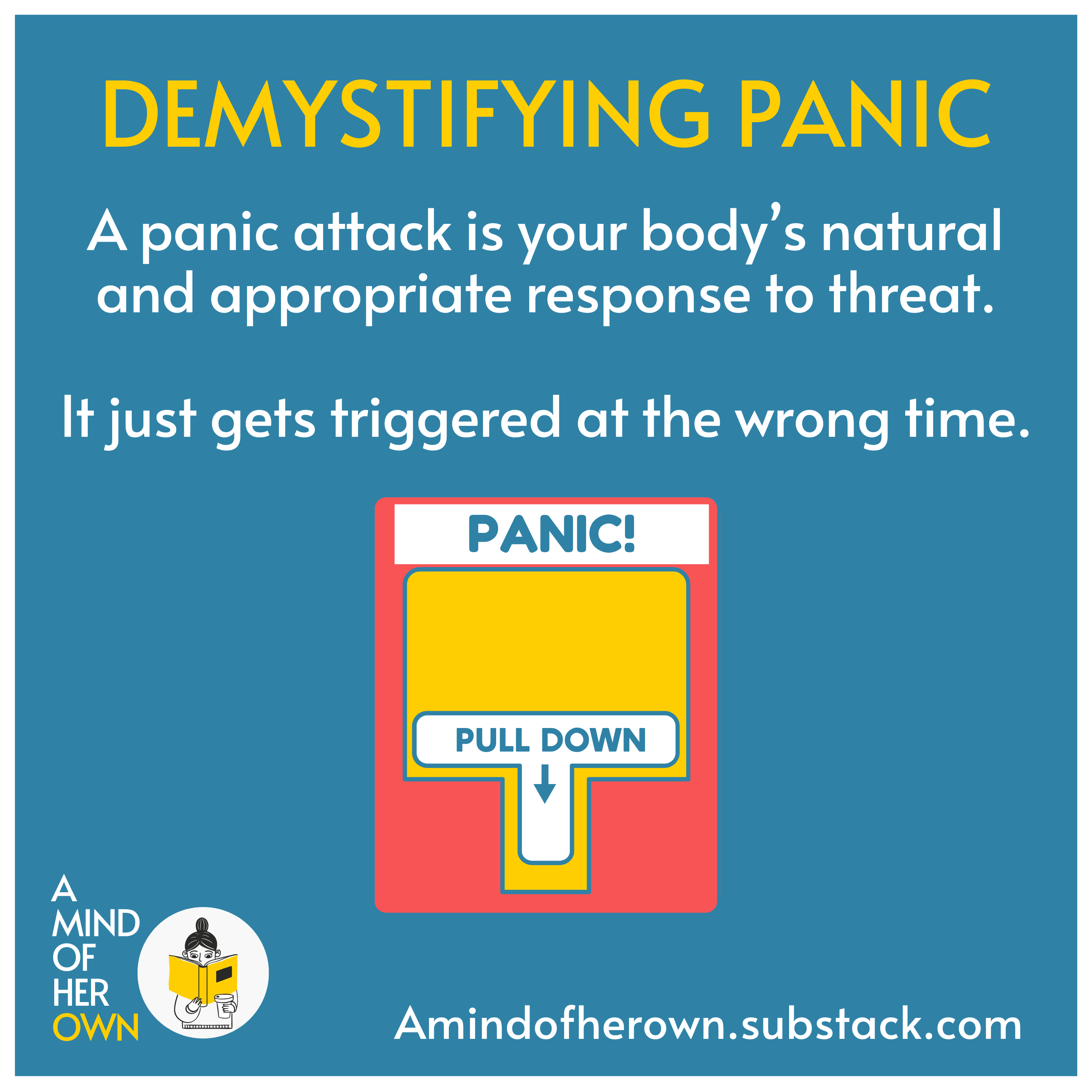
This next point is important enough to repeat: A panic attack is your body’s natural and appropriate response to threat. It just gets triggered at the wrong time. Maybe you were dehydrated after a long workout in the sun. Maybe you'd been seeing patients on the unit for several hours and forgot to eat. Maybe you were anxious because your kids were going back to school after an illness and you were worried it was too soon. Whatever the initial reason, you start feeling shaky or lightheaded, and think “Something must be really wrong.” Sometimes, that’s all it takes to trigger a panic attack. Once that adrenaline is released, the rest is just biology.
Unfortunately, by the time they come to my office, many people have been struggling with panic attacks for months or even years, slowly removing activities from their lives that they fear might trigger a panic attack (exercise, social gatherings, sex!), and living under the shadow of anxiety.
I wish more people knew what a panic attack is, and, even more importantly, what it isn’t: dangerous. Many of us will experience a panic attack in our lives. If more people understood its cause and its reflection of a natural, human process, this would mean fewer lost moments with family, fewer hours distracted and fearing another panic attack, and more freedom to live our lives.
It’s a vicious cycle, but one that can be broken with a straightforward explanation of why this happens, and the confidence that it is highly treatable. I have seen so many people overcome these experiences and truly move forward with their lives.
You are not going crazy, panic attacks are not dangerous, and they don’t have to control you. Help is out there.
(p.s. For any OG’s here, part of this essay appeared on my prior blog.)
A horrible feeling! And more like a reflex than a chosen emotional response. A dash of propranolol when situational can be a life saver. But the random ones are real torture, glad you help people with these!